Alternative Credit Data: Definition, Types, and Modern Fintech Integration

Quick Definition
Alternative credit data refers to any financial, transactional, or behavioral information used to assess a borrower’s creditworthiness that is not traditionally captured in standard credit bureau reports (such as major credit card balances, auto loans, and mortgages). Common examples include rental payment history, utility and telecom bills, bank account cash-flow analytics, Buy Now Pay Later (BNPL) records, and verified payroll data.
What Is Alternative Credit Data?
In modern lending and risk modeling, alternative credit data (often abbreviated as ACD) represents non-traditional financial indicators that provide a more granular, real-time picture of a consumer’s or business’s financial health and payment behavior.
Much of this data qualifies as consumer-permissioned data: financial information a consumer explicitly authorizes a third party to access and share.
Historically, credit scoring models like standard FICO® and VantageScore® relied primarily on traditional credit bureau data sourced from the nationwide consumer reporting agencies (Equifax, Experian, and TransUnion). This legacy data consists of:
- Revolving credit lines (credit cards, store cards)
- Installment loans (student loans, personal loans, auto loans)
- Real estate loans (mortgages, home equity lines)
- Public records & collections (formal debt judgments, bankruptcies)
While effective for mature borrowers with established borrowing histories, traditional metrics systematically exclude or penalize millions of creditworthy individuals who manage recurring financial commitments outside traditional credit channels.
Alternative credit data bridges this information asymmetry by capturing everyday financial reliability, transforming recurring cash flows and non-debt obligations into actionable risk signals.
Traditional Credit Data vs. Alternative Credit Data
| Feature | Traditional Credit Bureau Data | Alternative Credit Data (ACD) |
| Primary Data Sources | Banks, credit card issuers, mortgage lenders, collection agencies | Property managers, utility providers, Telecom providers, bank transaction streams, payroll APIs |
| Update Frequency | Monthly batch cycles (Metro 2® format) | Real-time to near-real-time API feeds |
| Data Scope | Formal debt repayment, credit limits, credit utilization | Cash-flow velocity, recurring bill payments, liquid assets, income stability |
| Consumer Access Barrier | Catch-22 for the consumer: can’t get a credit score without taking on debt; can’t get debt without a credit score. | Accessible via everyday financial behavior and banking history |
| Underwriting Focus | Past debt management behavior | Behavior managing everyday payments. Present cash liquidity and real-time ability to repay. |
| Coverage Impact | Leaves 45- 50 million consumers “thin-file” or “unscored” | Provides visibility into “credit invisible” and immigrant populations |
Primary Types of Alternative Credit Data
Financial institutions and fintech developers leverage several distinct categories of alternative data to enhance underwriting algorithms:
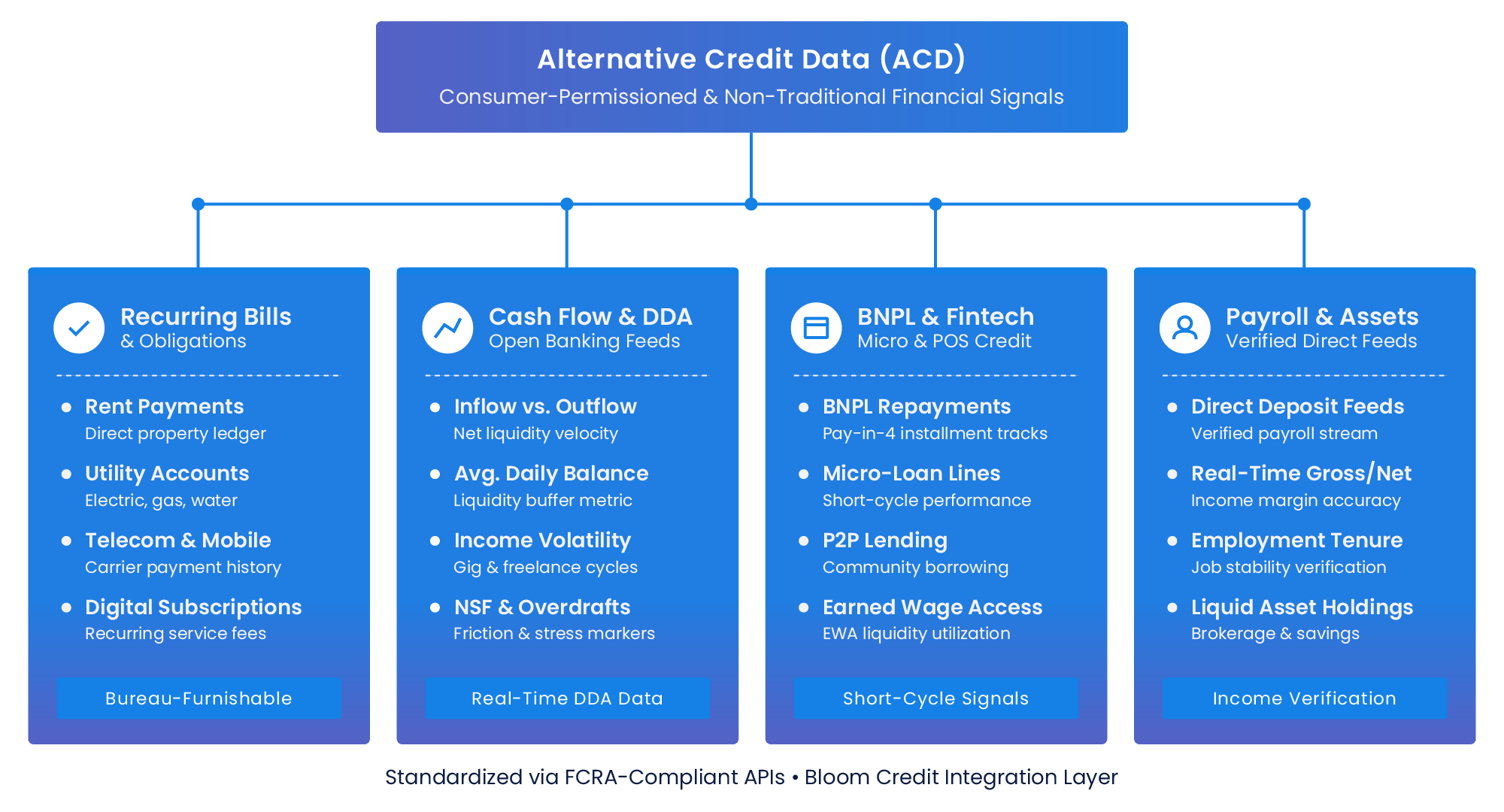
1. Recurring Bill & Utility Payment Records
- Rental Payments: On-time rent reporting is one of the strongest predictors of future mortgage and installment loan performance.
- Telecom & Utility Accounts: Consistent payment records for electricity, gas, water, and mobile service providers show long-term budget discipline.
- Subscription Services: Regular payments for recurring digital services, memberships, and software.
2. Cash-Flow & Bank Transaction Data (Open Banking)
Consumer-permissioned data is financial data a consumer has authorized a lender or platform to access directly from a bank, employer, or other source. Through consumer-permissioned open banking APIs, lenders can analyze raw demand deposit account (DDA) data to assess:
- Net Cash Flow: Real-time inflow versus outflow ratios.
- Average Daily Balance (ADB): Liquidity buffers against financial shocks.
- Income Volatility: Regularity and stability of gig-economy, freelance, or seasonal income.
- Risk Indicators: Non-sufficient funds (NSF) events, overdraft frequency, or high-risk merchant transactions.
3. Buy Now, Pay Later (BNPL) & Short-Term Credit
- Point-of-sale financing (e.g., Affirm, Klarna, Afterpay) and short-term micro-loans that demonstrate punctual fulfillment of short-cycle installment contracts.
4. Verified Income, Employment & Asset Data
- Real-time payroll connectivity and verified direct deposits that validate continuous employment tenure, gross-to-net pay margins, and tax withholding without manual pay stub verification.
Why Alternative Credit Data Matters
1. Solving the “Credit Invisible” Challenge
According to the Consumer Financial Protection Bureau (CFPB), approximately 45 to 50 million Americans are either “credit invisible” (having no credit history at the nationwide consumer reporting agencies) or “unscored / thin-file” (lacking sufficient recent history to generate a standard credit score). Alternative credit data empowers lenders to safely extend credit to underserved demographics, including invisible prime borrowers: creditworthy consumers who lack the traditional bureau history needed to prove it, including:
- Young adults and recent graduates
- Immigrants and international workers with no domestic bureau history
- Cash-preferred and unbanked/underbanked households
- Gig-economy workers and independent contractors
2. Enhanced Predictive Power & Risk Modeling
Traditional credit scores provide a backward-looking summary of historical debt management. When combined with real-time cash flow and bill payment histories, risk teams benefit from:
- Lower Default Rates: Better detection of hidden debt distress or liquidity shortages not yet reflected on bureau reports.
- Increased Approval Rates: Converting marginal “thin-file” rejections into profitable, performing loans.
- Dynamic Risk-Based Pricing: Offering customized APRs and credit limits aligned with real-time capacity to pay.
Modern Integration: How Fintechs and Lenders Ingest Alternative Data
Deploying alternative credit data historically required complex, bespoke integrations with disparate data aggregators. Modern infrastructure providers like Bloom Credit streamline this pipeline through unified API architectures:
- Consumer Consent & Permissioning: Secure OAuth and direct verification flows enable consumer-permissioned data collection, ensuring compliance with CFPB Section 1033 open-banking standards.
- Unified Data Normalization: Ingesting raw JSON payloads from multiple aggregators, utility furnishers, and transaction feeds, converting them into standardized bureau-ready or underwriting-ready formats.
- Furnishing & Bi-Directional Reporting: Enabling FIs to not only consume alternative data for origination decisions, but also furnish proprietary customer repayment data back to bureaus in compliant Metro 2® formats.
- Automated Analytics & Scoring Integration: Direct feeding into modern automated credit decision engines and custom scorecards.
Compliance and Regulatory Considerations
Utilizing alternative credit data requires rigorous adherence to federal consumer protection and lending laws:
- Fair Credit Reporting Act (FCRA): Any entity providing alternative consumer data used for credit eligibility decisions is classified as a Consumer Reporting Agency (CRA) or data furnisher, subject to strict dispute resolution, accuracy standards, and permissible purpose requirements.
- Equal Credit Opportunity Act (ECOA) & Regulation B: Lenders must ensure alternative data variables do not produce illegal disparate impact or proxy discrimination against protected classes (e.g., using non-traditional geographic or educational variables improperly).
- Adverse Action Notices: When an adverse credit decision is based in whole or in part on alternative credit data, lenders must provide clear, actionable reasons explaining the specific factors that contributed to the denial.
- Data Privacy & Security: Adherence to SOC 2 Type II, GLBA, and end-to-end encryption protocols is mandatory when handling sensitive financial transaction records.
Frequently Asked Questions (FAQ)
What is the difference between alternative credit data and traditional credit data?
Traditional credit data consists of formal debt accounts (credit cards, mortgages, auto loans) reported monthly to the three major credit bureaus. Alternative credit data includes non-debt financial indicators such as rent payments, utility bills, bank account cash flow, and payroll data that do not traditionally appear on standard credit reports.
Does alternative credit data replace traditional credit bureau scores?
No. In most institutional lending environments, alternative credit data complements rather than replaces traditional credit scores. It is primarily used to augment credit decisioning, score previously unscoreable applicants, or refine risk-based pricing.
Does collecting alternative credit data require consumer permission?
Yes. Access to consumer-permissioned data, including bank transactions, utility accounts, and payroll records, requires explicit consumer consent under the Fair Credit Reporting Act (FCRA) and modern open-banking regulations (CFPB Section 1033).
How does reporting rent and utilities help build credit?
When rent and utility payment data is furnished through an FCRA-compliant platform to credit reporting agencies, positive payment records are incorporated into newer credit scoring models (such as VantageScore 3.0/4.0 and FICO Score 9/10), establishing and elevating credit scores for previously thin-file consumers.
What does ‘invisible prime’ mean?
Invisible prime refers to consumers who manage credit responsibly but have no or limited traditional bureau history, making them appear high-risk or unscoreable despite strong underlying financial behavior. Alternative credit data helps surface this hidden creditworthiness.